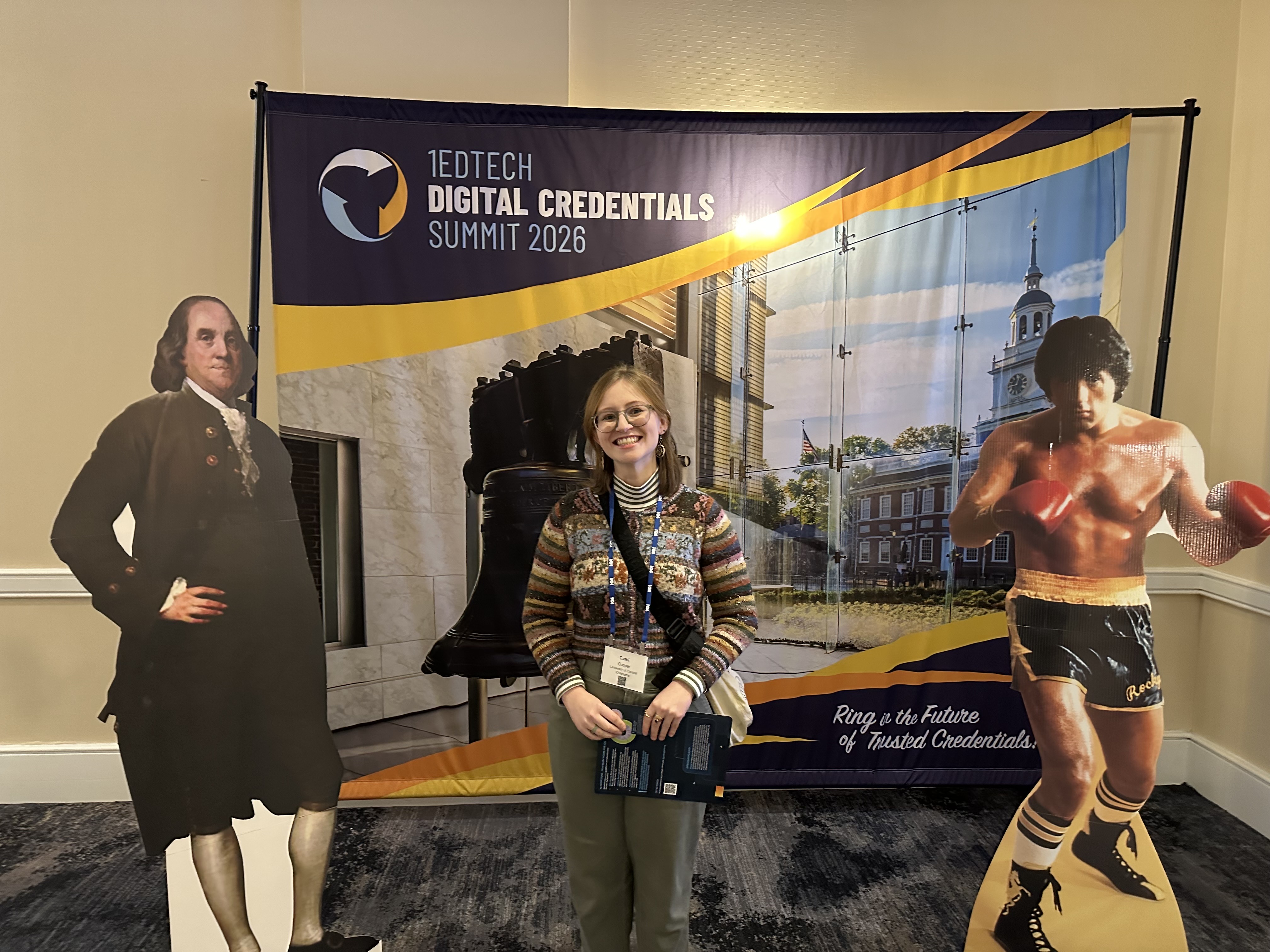
This marked my fourth year attending the Digital Credentials Summit on behalf of LX Studio. As the micro-credential program coordinator at the University of Central Oklahoma, I do my darndest to stay on top of emerging trends, and the bevy of related conferences are a wonderful way to connect with the most innovative ideas and people in this space. The 2026 Summit left me with a few key takeaways that I will be carrying forward this year:
- Despite the widespread push for higher education to improve its hiring outcomes for students, we cannot make the mistake of collapsing education and work completely. To paraphrase Meena Naik's point in the excellent Wednesday plenary: "Employment must be the side effect of education, not the goal." In curating our educational programs with the holistic development of our students top of mind, we can produce highly-skilled, highly-employable individuals. Alternative credentials are a critical part of augmenting and supplementing the competencies our students will already gain through their university education. We do not have to (and should not strive to) reinvent higher education in order to drive economic mobility for our students. What is our responsibility is ensuring that employability is a byproduct of a university education.
- This nugget also comes from Wednesday's plenary, but I can't recall to whom it should be attributed (apologies!) -- "Everything is becoming hyperlocal again." The internet has (to put it mildly) completely reshaped the ways that people learn, work, and live in the last 4-odd decades. Since, the prevailing attitude has been that a recent college graduate has an equal chance at a job halfway across the world as they do a job down their street. But in the last few years (especially with the rise of AI) employers have shown symptoms of choice saturation. If every decision we make, whether it is choosing a cleaning product to buy, or hiring a new employee, requires sifting through hundreds, if not thousands, of similar options, how do we make our decision? In the last year, the evidence has begun pointing to familiarity as a key decision-making factor. Name-recognition of universities may begin to matter more than ever as cookie cutter AI resumes inundate the market. This means that your university clout can make the biggest impact locally -- where employers know and respect you.
- Existing infrastructure is weighing us down. Whether it's Applicant Tracking Systems that refuse to ingest Open Badges, an LMS that isn't CASE-compatible, or terminology like LER/CLR that is meaningless to the uninitiated, we need to develop alternative solutions.
- 1EdTech had a great breakout session exploring survey data from vendors and employers, digging into barriers for operationalization. As they said, "LER adoption depends on credentials moving across systems," but their data showed that only 4.7% of surveyed credential platforms feel that current APIs used for sharing credentials are sufficient. That's a serious challenge for expansion! But I'm confident that it will be met enthusiastically by the excellent vendors and thinkers in this space.
- A potential solution for the language barrier has recently been announced: "Trusted Career Profile" in place of "LER/CLR". I'm very pleased to see the industry moving towards language that is legible to the average employer and employee.
Finally, (braggadociously), I came away from the conference very proud of UCO's impact on the alternative credentialing space. I was the undeserving recipient of innumerable compliments for the STLR team and their amazing work. I'm grateful to work for a university with such a strong reputation as an innovator, and I am excited to be part of STLR's next chapter as we marry it with the LER (now Trusted Learner Profile?) model. I had the opportunity to chat with many other LER Accelerator participants and learn from their progress, and I am enthusiastic about the work ahead!
Stay up to date on what we are doing at LX Studio by subscribing to our blog!

.jpg)

.png)