

You know all the training your team needs. You’ve got compliance requirements, onboarding modules, continuing education credits, skill-building programs. What you might not realize is that the system delivering it all—multiple platforms, scattered access points, unclear requirements, and a navigation maze—is creating cognitive overload before learners ever open a single course.
A nonprofit leader I worked with was drowning in this exact problem. She managed training for multiple departments across different professional fields, each with their own certification requirements. Training was tracked in one system, accessed through another, delivered via three different platforms. Even she—the head trainer—didn’t know the full scope of required training. Her learners were burning mental energy just figuring out where to go and what they needed, leaving little cognitive capacity for actual learning.
This is cognitive overload in training, and it’s killing engagement in ways that have nothing to do with content quality or learner motivation.
The Brain’s Bandwidth Problem
Here’s what makes this so insidious: the human brain can only process a limited amount of new information at once before it starts dropping critical pieces. Think of working memory like a mental workspace with finite square footage—you can only spread out so many projects before something falls off the table.
When that nonprofit leader’s team members logged in to complete their annual training, their brains were already working overtime. Which platform has the module I need? Is this the same login as last time? Did I already complete this or was that a different version? What’s actually required versus recommended? Each navigation decision, each moment of uncertainty, each click to find the right resource consumed cognitive capacity that should have been available for learning.
According to cognitive load theory, three types of mental effort combine to determine whether someone can actually learn:1
Intrinsic load comes from the complexity of what you’re teaching. Compliance regulations are inherently complex—you can’t simplify the content itself, but you can control everything around it.
Extraneous load is wasted mental effort caused by poor design—confusing navigation, scattered resources, unclear instructions, or having to hunt for what you need. This is the cognitive cost of your delivery system, and it’s entirely preventable.
Germane load is the productive thinking required to actually understand and remember new information. This is where learning happens—when the brain builds connections, recognizes patterns, and moves information into long-term memory.
Here’s the problem: these three types of load are additive2. When extraneous load from system chaos eats up mental capacity, there’s less available for the germane load that creates actual learning. Your content could be perfectly designed, but if learners are mentally exhausted from navigating to it, learning won’t stick.
What Overload Actually Looks Like
Back to that nonprofit leader. Once we mapped what was actually happening, the problem became clear. Her team wasn’t struggling because the training was too hard or they weren’t motivated. They were struggling because the system itself demanded too much cognitive effort before learning could even begin.
The solution wasn’t about changing the training content. It was about reducing extraneous load by creating a coherent system. Everything moved to one platform. Access became predictable. Required training was clearly identified and separated from optional resources. Tracking became automatic instead of manual.
The transformation wasn’t dramatic—no flashy redesign, no expensive new tools. But learners stopped asking “where do I find this?” and started asking “how do I apply this?” That shift represented freed cognitive capacity redirected from system navigation to actual learning.
This pattern shows up everywhere once you know to look for it. Completion rates stay high while behavior change flatlines—learners are processing so shallowly the information never reaches memory. New hires complete every onboarding module but still ask basic questions the next week—information overload prevented schema formation. These aren’t motivation problems. They’re cognitive load problems masquerading as engagement issues.
Five Design Moves That Reduce Overload
Whether you’re managing training across multiple teams or trying to build something sustainable instead of constantly firefighting, these strategies reduce extraneous load and create space for actual learning:
- Chunk strategically, not arbitrarily. Breaking content into smaller pieces doesn’t automatically reduce cognitive load—the chunks need to be meaningful units learners can process completely before moving forward. Each chunk should represent one complete concept that builds toward the next.
- Space learning over time. Cramming everything into one session creates cognitive pile-up. The brain needs time between learning episodes to consolidate information and move it from working memory into long-term storage. For critical skills, build retrieval practice into the system: a touchpoint three days out, another a week later, then a month after initial learning.
- Signal what matters. Extraneous load hides in things we’ve stopped noticing—multiple navigation menus, inconsistent labeling, decorative graphics that compete for attention, instructions buried three clicks deep. Every element should serve learning or get out of the way. Make access points obvious. Make requirements crystal clear. Make the path forward unmistakable.
- Leverage dual channels. Visual and auditory information use separate processing pathways in the brain. When designed thoughtfully, this expands available mental bandwidth rather than creating redundancy. A well-produced video with synchronized narration and reinforcing on-screen text reduces load compared to dense slides with competing visual elements.
- Build guided reflection moments. Learning doesn’t happen through passive information delivery—it requires active mental work to build understanding and create memory. Brief, structured reflection prompts throughout training help learners construct meaning rather than just consume content. Instead of “what did you learn?” ask “how does this connect to the challenge you faced last week with X?”
Try This: Audit Your Cognitive Load
We’ve created a practical checklist that walks you through all four categories—extraneous load, intrinsic load, germane load, and sustainable attention design—with diagnostic questions you can apply to any training system or learning experience immediately.
➡ Download the full Cognitive Load Audit
Making Your Design Thinking Visible with LEM
One challenge with reducing cognitive overload is knowing exactly where it lives in your current design. The audit above identifies the categories. But if you’re looking at your existing training and wondering “where exactly is the friction?”—that’s the right question.
This is where Learning Environment Modeling™ (LEM) helps. Just as architects use blueprints to make building design visible, LEM creates visual models that map how a training experience flows from the learner’s perspective. Every element in the model is represented by one of five building blocks: Information, Dialogue, Practice, Feedback, and Evidence—each placed within a specific context (classroom, online, or experiential).
When you map a training design through the LEM lens, cognitive load problems become visible:
- Information blocks reveal intrinsic load: Is content sequenced to build schema, or are learners encountering complexity before they have the foundation to hold it?
- Extraneous load shows up as design clutter—fragmented navigation, inconsistent touch points, competing visual elements. These don’t appear as “learning” in a LEM blueprint because they aren’t. Removing them is a design decision you can see and commit to.
- Germane load lives in the Dialogue, Practice, and Feedback blocks—the moments where learners retrieve, apply, and connect knowledge. When these blocks are sparse, the blueprint makes it immediately clear.
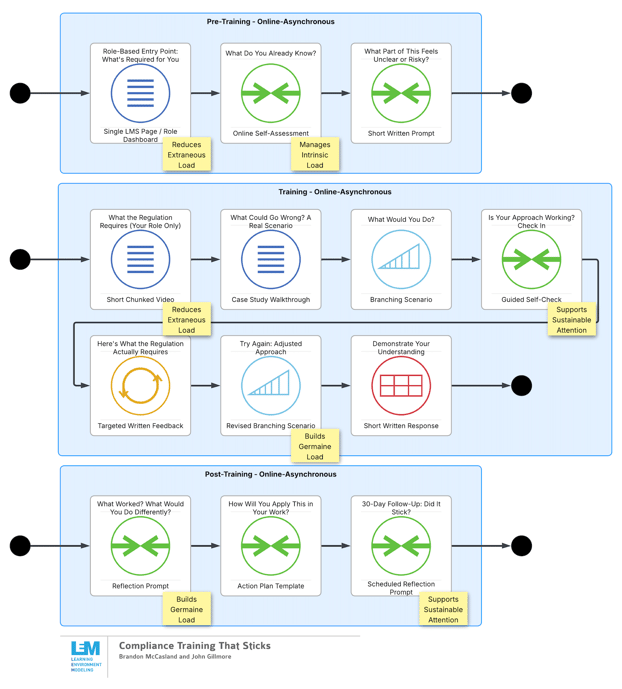
Image alt. text: Learning Environment Model blueprint showing Information, Practice, Feedback, and Dialogue blocks mapped to cognitive load reduction strategies.
When we create these visual models with teams, something consistent happens: design thinking becomes visible. It’s suddenly easy to spot where cognitive load is concentrated, where active processing is absent, and where learners are being asked to do too much at once. Learn more about how authentic learning contexts drive performance.
Designing for How Brains Actually Work
In our work with L&D teams redesigning training systems, the pattern is remarkably consistent. The problem isn’t that learners can’t handle the content. It’s that we’re asking their brains to do too much, in too many competing ways, all at once.
That nonprofit leader didn’t need more content or better modules. She needed a system—something intentional and coherent where nothing competed for mental energy unnecessarily. Once mapped, she could design instead of react. One clear entry point replaced multiple scattered platforms. Navigation became predictable instead of a guessing game. None of this changed the content itself—it eliminated the cognitive cost of chaos so learners’ mental energy could go toward actual learning.
Her teams still complete the same training requirements. But now they retain it, apply it, and build on it—because their brains have the bandwidth to do the real work of learning instead of burning cognitive capacity on system navigation.
The shift from “we need to cover everything” to “we need to design for how brains actually process information” feels risky at first. But sustainable attention isn’t about training less—it’s about creating the conditions where training can actually work.
Want to see chunking in action? Follow along for our upcoming Neuroscience of Engagement blogs.
Sources
1 Office of Educational Improvement, Medical College of Wisconsin. (2022). Cognitive Load Theory: A Guide to Applying Cognitive Load Theory to Your Teaching. https://www.mcw.edu/-/media/MCW/Education/Academic-Affairs/OEI/Faculty-Quick-Guides/Cognitive-Load-Theory.pdf
2 Sweller, J., van Merriënboer, J. J. G., & Paas, F. (1998). Cognitive architecture and instructional design. Educational Psychology Review, 10(3), 251–296. doi: https://doi.org/10.1023/A:1022193728205
View our resource library that inspired our Neuroscience of Engagement series.
.jpg)

.png)