
When most people hear the word “reflection,” they think of monks in contemplative silence or graduate seminars where students analyze theory. It sounds slow, introspective, maybe even impractical. Certainly not something frontline employees or technical staff need to do.
This is exactly the problem.
We tend to treat reflection as something reserved for certain levels of education or fancy leadership development programs. Meanwhile, the people who most need reflective capacity—customer service reps handling difficult conversations, nurses making rapid clinical decisions, new hires navigating unfamiliar procedures—are left to figure out how to improve on their own.
But here's what neuroscience and workplace learning research tell us: reflection isn't contemplation. It's the skill that bridges the gap between what learners know and what they actually do on the job.1 When you train people to reflect—not just about their work, but in their work—the learning sticks, performance improves, and people carry that capability with them long after your training ends.
The question isn't whether reflection matters. It's whether we're willing to design it into training for all roles, not just the ones we think have time to think.
The Missing Link Between Metacognition and Action
In our previous post on metacognition, we explored how learners need to understand how they learn in order to make training stick. Metacognition—thinking about thinking—is the foundation. But reflection is the practice that makes metacognition actionable.
Metacognition helps learners become aware of their thinking process.
Reflection helps them use that awareness to improve performance in real time.
Reflection isn't a single activity—it's a set of practices that happen before, during, and after action.1 Professionals who excel don't just think back on what they did. They develop the ability to adjust their approach while they're doing it—it’s called “reflection-in-action.” 2
Metacognition gives you self-awareness. Reflection gives you the process to act on that awareness in authentic, high-stakes moments. And this isn’t actually slower—reflection actually speeds up learning by strengthening the neural connections needed for performance.3
The Three Types of Reflection That Drive Transfer
Effective professionals don't just reflect after the fact. They use three distinct types of reflection that happen at different points in their work1:
Reflection-in-Action (During the Task)
This is “thinking on your feet.” It's the ability to notice when your current approach isn't working and adjust in real time. A customer service rep realizes a standard script isn't landing and shifts to a more empathetic approach. A nurse notices a patient's nonverbal cues and pauses to ask a clarifying question.
Reflection-in-action requires learners to develop an internal monitoring system—an awareness of what's happening as it's happening. This is where metacognition becomes practical. When you've trained someone to ask “Is this strategy working right now?”, they can course-correct before small problems become big ones.
Reflection-on-Action (After the Task)
This is the reflection most of us are familiar with. After completing a task or project, learners step back and analyze what happened. What worked? What didn't? Why? What would I do differently next time?
Reflection-on-action helps learners extract lessons from experience and build their mental repertoire of strategies. It's essential for continuous improvement. But here's the problem: most training includes generic reflection prompts that don't connect to the learner's specific context.
Questions like “What did you learn today?” don't help. Better questions tie directly to performance: “Which strategy worked best for handling objections in your territory?” or “What cues told you the procedure needed adjustment?”
Reflection-for-Action (Before the Next Task)
This is the most overlooked form of reflection, but it may be the most powerful for transfer. Reflection-for-action involves using insights from past experience to prepare for the next challenge.
Before a difficult conversation, a manager reflects on what worked in previous coaching moments and plans an adjusted approach. Before a technical task, a specialist considers which troubleshooting strategies are most likely to apply.
This type of reflection turns learning into a continuous cycle. It's not just “reflect after you’re done.” It's “reflect so you’re ready.” When learners develop this habit, they carry the training forward into every new situation they encounter.
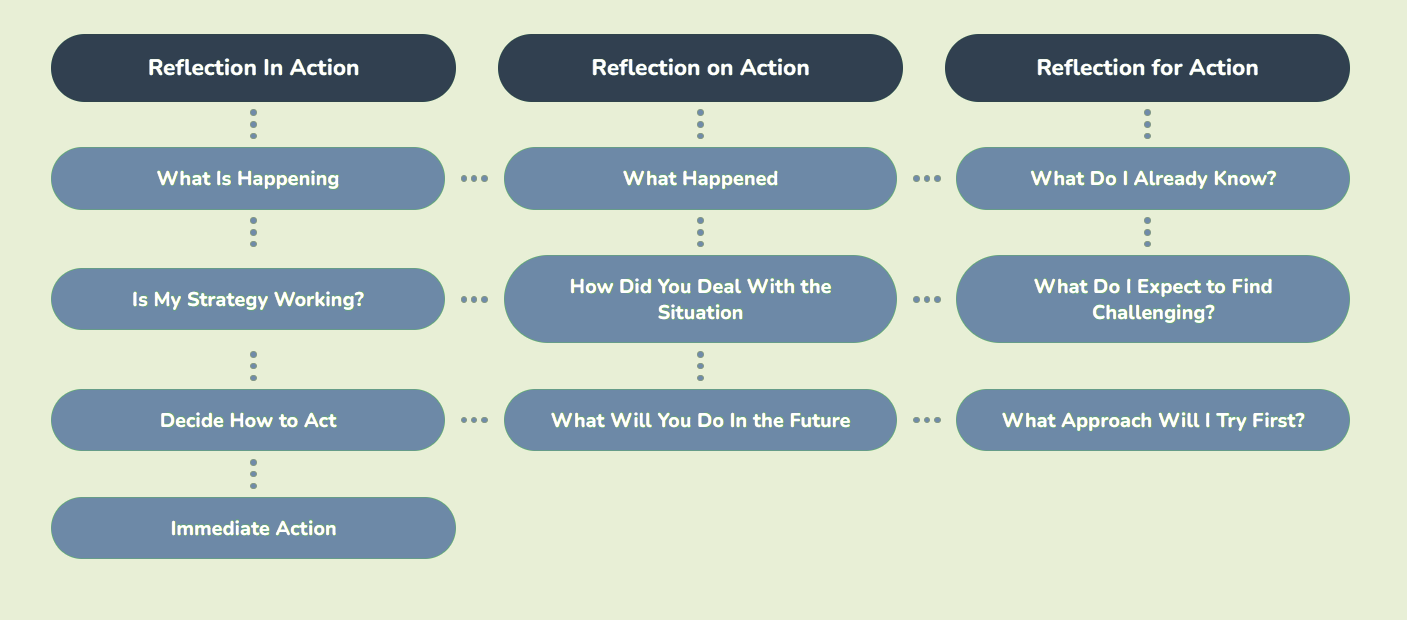
Image alt. text: Diagram showing three types of reflection: reflection-in-action (during), reflection-on-action (after), and reflection-for-action (before the next task).
Making Reflection Transferable Across All Roles
The key to making reflection work across your organization—not just in leadership development—is to design it into training in targeted, role-specific ways. Here's how:
Embed Reflection in Authentic Contexts
Don't ask people to reflect on generic scenarios. Give them real problems from their actual work environment. Use case studies drawn from their job. Build simulations that mirror the complexity and constraints they face.
Authentic contexts [LINK TO AUTHENTIC CONTEXTS BLOG POST] trigger motivation, and motivation drives rehearsal. When learners care about the problem, they'll invest the cognitive effort needed to reflect deeply.
Make the Reflection Prompts Specific
Generic prompts produce generic insights. Instead of "What did you learn?", ask:
- "What signal told you to switch strategies?"
- "Which part of the process felt uncertain, and how did you navigate it?"
- "What will you do differently in the next similar situation?"
Specific prompts help learners build transferable mental models—templates they can apply again and again.
Create Space for All Three Types of Reflection
Don't limit reflection to the end of training. Build in moments for reflection-in-action (mid-task check-ins), reflection-on-action (structured debriefs), and reflection-for-action (planning prompts before practice).
When learners experience all three types, they begin to internalize the reflective process. It becomes automatic. They start doing it without your prompts.
Your Reflection Design Checklist
Ready to embed reflection into your next training program? We've created a practical checklist that walks you through how to design all three types of reflection—in-action, on-action, and for-action—plus transfer strategies for long-term retention.
➡ Download the full Reflection Design Checklist
Making Your Design Thinking Visible with LEM
One challenge with embedding reflection is that it's hard to see where it's missing in your existing training. If you've read the checklist above and thought, "Great—but where exactly does this go in my design?"—you're asking the right question.
This is where Learning Environment Modeling (LEM) helps. Just as architects use blueprints to make building design visible, LEM creates visual models that map how a training experience flows from the learner's perspective. Every element in the model is represented by one of five building blocks: Information, Dialogue, Practice, Feedback, and Evidence—each placed within a specific context (classroom, online, or experiential).
When you look at a reflective training design through the LEM lens, the three reflection types map directly onto the blueprint:
- Reflection-in-Action lives in the Practice and Feedback blocks. This is the monitoring loop—learners try a strategy, get real-time feedback, notice what's working, and adjust. When designed well, these blocks create the conditions for thinking on your feet.
- Reflection-on-Action appears as Dialogue blocks after practice sequences. These are the structured debriefs where learners step back, extract lessons, and build their mental repertoire. The quality of the prompt matters: role-specific questions produce transferable insights; generic ones don't.
- Reflection-for-Action shows up as Dialogue blocks before new practice opportunities—planning prompts that ask learners to anticipate challenges and select strategies. When paired with an Evidence block, learners can also capture commitments they carry forward to real work.
.png?width=469&height=497&name=Reflection%20-%20Reflection(1).png)
Image alt. text: Learning Environment Model blueprint highlighting Dialogue, Practice, and Feedback blocks where reflective prompts are embedded across a training sequence.
This visual approach transforms abstract concepts like reflection into concrete design decisions. In our work with organizations, we've seen it help teams embed reflective practice into everything from compliance training to leadership development—without adding significant time or resources.
Designing Reflection Into Your Training Systems
At LX Studio, we work with teams to embed reflective practice across all levels of their training programs—not just leadership development. We help organizations identify where reflection is missing, design role-specific prompts that drive transfer, and build training systems that make reflection a core capability for every learner.
Whether you’re designing onboarding for frontline employees, compliance training for technical staff, or development programs for emerging leaders, reflection is the skill that makes everything else stick. When you teach people how to reflect—not just that they should reflect—you’re building a workforce that learns faster, performs better, and continuously improves.
Want to explore how to build reflective practice into your training programs? Subscribe to our newsletter for learning design insights grounded in research and practice.
Interested in learning more about learning science for training? Check out the Neuroscience of Engagement series.
Sources
- Schön, D. A. (1983). The Reflective Practitioner: How Professionals Think in Action. Basic Books.
- The distinctions between reflection-in-action, reflection-on-action, and reflection-for-action are explored in Schön (1983) and extended in: Killion, J., & Todnem, G. (1991). A process for personal theory building. Educational Leadership, 48(6), 14–16.
- Schlichting, M. L., & Preston, A. R. (2014). Memory reactivation during rest supports upcoming learning of related content. Proceedings of the National Academy of Sciences, 111(44), 15845-15850.
View our resource library that inspired our Neuroscience of Engagement series.
.jpg)

.png)