

Brains on Borrowed Time: What Students Lose — and Gain — When AI Thinks for Them
AI can make students look smarter while making them think less.
Building learning experiences for an era when learners have AI at every moment presents a tough design challenge. For educators, AI use looks the same whether it's helping a student learn or doing the work for them.
Yet a growing body of research points to what many instructors have already sensed: students who rely heavily on AI during learning tasks show measurably lower cognitive engagement — less deep processing, less mental effort, less strategic thinking. The same research also shows that offloading mental effort to external tools is one of the things human cognition does best, under the right conditions. Which outcome you get depends less on the tool than on how the work around it is designed.
What Is Cognitive Offloading — And Why It Matters
Cognitive offloading is just a technical term for something humans have always done: use the world around us to reduce the mental effort a task requires.1
You write a grocery list instead of trying to remember fifteen items. You tilt your head to read a rotated sign instead of mentally rotating the letters. You set a reminder for a meeting instead of spending energy trying to remember it. All of that is cognitive offloading — and all of it is completely normal and useful.
This is ancient human behavior. Finger-counting, the abacus, knot-based record systems, handwritten notes — all forms of cognitive offloading that have helped people accomplish cognitive feats they couldn't manage with unaided memory alone. The brain has real limits: working memory is finite, attention is selective, and recall is imperfect.1 Offloading helps us work around those limits.
AI is simply the most powerful offloading tool humans have ever had access to.1 That's not a problem. But it does raise the central question for learning designers: what cognitive work was the learner supposed to be doing — and are they still doing it?
What Happens When AI Does the Thinking
Recent research shows AI tends to improve what students produce while reducing how much they think.
- Students who used ChatGPT to complete a writing task reported less deep thinking, less mental effort, and weaker focus than students who completed the same task without AI — even when their finished work looked comparable on the surface.2,4
- Math students who practiced with AI help answered more questions correctly — but scored lower at understanding concepts. They got better at performing the task without getting better at understanding it.3
- Students who write essays with AI assistance had weaker neural activity and worse memory recall than those who wrote without — and those effects lingered even after the tool was taken away.4
The pattern across all of it: AI reduces the friction of output. And friction is often where the learning actually happens.5
But it's not all bad news. AI tutoring in STEM has shown real score gains.⁶,⁷ AI tools have shown measurable gains across core language-learning skills.⁸
In every positive case, learners were still doing the central cognitive work themselves; AI handled the edges of it.
Productive Offloading vs. Harmful Dependency
Not all cognitive offloading is equal. The key question is whether the work being offloaded is necessary for the learning goal.
Think of it this way: if a student uses AI to format a bibliography so they can spend more time analyzing sources, that's productive. If they use AI to generate the analysis itself, that's the learning goal walking out the door.
Productive AI offloading looks like:
- Using AI to handle repetitive or administrative tasks so learners can focus on higher-order thinking
- Using AI to generate a first draft that learners then critique, revise, and improve
- Using AI to provide real-time feedback so learners can iterate more quickly
- Using AI to translate or summarize so learners can focus on meaning-making and application
Harmful AI dependency looks like:
- Using AI to answer questions the learner was supposed to work through themselves
- Submitting AI-generated work without critical engagement or synthesis
- Skipping the productive struggle that builds conceptual understanding
- Replacing retrieval practice — one of the most effective learning strategies available — with AI lookup
The research on AI-assisted creativity shows this line in action. When design students brainstormed with AI, it sped up idea generation — but it also narrowed their exploration and pushed teams toward early convergence, while human-only teams produced more varied, higher-quality work. The study read that gap as cognitive offloading: the AI quietly took over the divergent thinking the task was meant to develop, even as students' confidence in the results stayed high.⁹
The line between the two isn't always obvious in the moment, which is exactly why it needs to be a design decision. Asking whether an activity 'uses AI' tells you almost nothing. What matters is whether the learner is still doing the work the goal depends on.
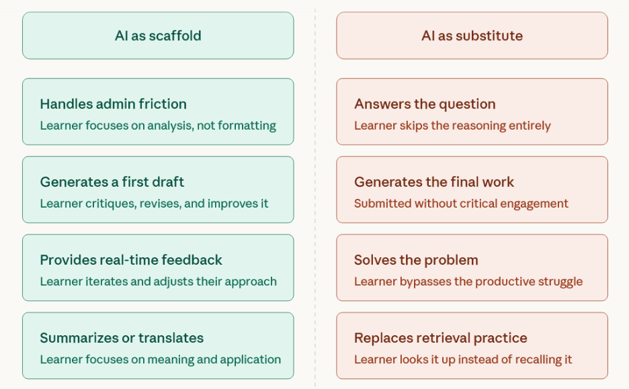
Image alt. text: A two-column comparison graphic titled 'AI as scaffold' on the left and 'AI as substitute' on the right. The left column has a green color scheme and lists four ways AI can support learning: (1) Handles admin friction — learner focuses on analysis, not formatting. (2) Generates a first draft — learner critiques, revises, and improves it. (3) Provides real-time feedback — learner iterates and adjusts their approach. (4) Summarizes or translates — learner focuses on meaning and application. The right column has a red color scheme and lists four ways AI can replace learning: (1) Answers the question — learner skips the reasoning entirely. (2) Generates the final work — submitted without critical engagement. (3) Solves the problem — learner bypasses the productive struggle. (4) Replaces retrieval practice — learner looks it up instead of recalling it.
Your AI Cognitive Load Design Audit
Use these questions as a quick gut-check before finalizing any AI-integrated learning experience. They're not meant to be exhaustive — they're meant to start the right conversation.
- What cognitive work is the learner supposed to be doing — and is the AI doing it instead?
- Is there a pre-task activation moment before learners access AI support?
- Are reflection prompts embedded that require learners to process or evaluate AI-generated content?
- Is there at least one AI-free retrieval or application moment?
- Does the practice task require the learner to exercise the target skill — or just review AI output?
- Does the evidence task require genuine performance that AI cannot substitute for?
- Is the learner positioned as decision-maker — or as a passive recipient of AI outputs?
➡ Download the full AI Cognitive Load Design Audit
How Learning Strategy Shapes AI's Role
In our work, the AI conversation starts at strategy, well before anyone picks a tool or builds an activity. We work through a set of questions that most teams skip: Who is this learner, really? What are they actually trying to accomplish? What do they struggle with? And what does genuine evidence of learning need to look like for this particular goal?
None of those sound like AI questions, yet they're what decides whether AI ends up helping or hurting. When you've defined what the learner needs to be able to do — and why it matters to them — it becomes much easier to see where AI can reduce unnecessary friction and where it would shortcut the work that builds the skill.
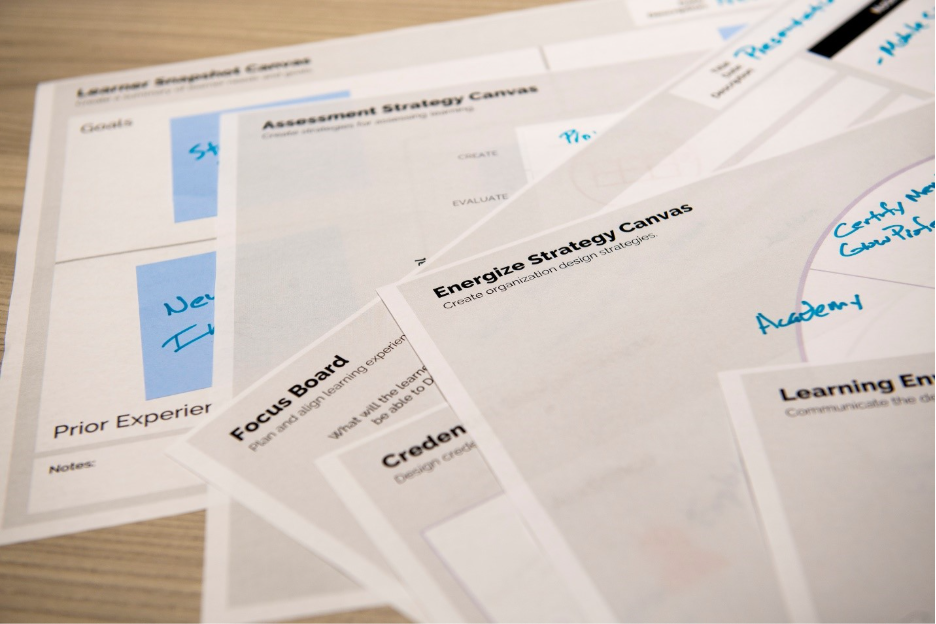
Image alt. text: A collection of LX Studio canvas worksheets fanned out on a table, including the Learner Snapshot Canvas, Assessment Strategy Canvas, Energize Strategy Canvas, Focus Board, and Learning Environment canvas. Several worksheets have handwritten notes in blue ink.
That upstream clarity is what separates AI integration that builds capability from AI integration that just accelerates completion — and it's the kind of thinking we bring to every learning design engagement. See how authentic learning contexts shape this kind of design.
If this kind of thinking resonates with how you approach learning design, we'd love to keep the conversation going. Subscribe to our newsletter for research-grounded insights from the LX Studio team, delivered to your inbox.
Note: Current research on AI-assisted learning is still emerging, and many studies focus on short-term outcomes or specific task types such as writing or tutoring. Findings should therefore be interpreted cautiously and applied with attention to instructional context.
Sources
View our resource library that inspired The Human Side of AI in Learning Series.
- Risko, E. F., & Gilbert, S. J. (2016). Cognitive offloading. Trends in Cognitive Sciences, 20(9), 676–688. https://doi.org/10.1016/j.tics.2016.07.002
- Georgiou, G. P. (2025). ChatGPT produces more ‘lazy’ thinkers: Evidence of cognitive engagement decline. University of Nicosia.
- Jose, B., Cherian, J., Verghis, A. M., Varghise, S. M., S, M., & Joseph, S. (2025). The cognitive paradox of AI in education: Between enhancement and erosion. Frontiers in psychology, 16, 1550621.
- Kosmyna, N., et al. (2025). Your Brain on ChatGPT: Accumulation of Cognitive Debt When Using an AI Assistant for Essay Writing Task. arXiv:2506.08872.
- Bjork, R. A., & Bjork, E. L. (2020). Desirable difficulties in theory and practice. Journal of Applied Research in Memory and Cognition, 9(4), 475–479.
- Fischer, M., Rau, H. A., & Rilke, R. M. (2025). AI tutoring enhances student learning without crowding out reading effort. IZA Institute of Labor Economics, 18338.
- Burns, M. (2026, January 27). What the research shows about generative AI in tutoring. Brookings. https://www.brookings.edu/articles/what-the-research-shows-about-generative-ai-in-tutoring.
- Torres, P. J., & Kahveci, Y. E. (2025). Effectiveness of Artificial Intelligence (AI) in language teaching. Computers and Education: Artificial Intelligence, 100522.
- Tsakalerou, M., Akhmadi, S., Balgynbayeva, A., & Kumisbek, Y. (2026). AI-assisted design synthesis and human creativity in engineering education. Frontiers in Artificial Intelligence, 9, 1714523.
AI Use Disclosure: This article was developed with the assistance of generative AI for drafting, refinement, and editorial support. The author reviewed, revised, and vetted the content and takes responsibility for the accuracy, conclusions, and final published version.
.jpg)

.png)