
AI Training for Employees - Where is Your Team with AI?
Consider two organizations that buy the same off-the-shelf AI training for employees: a fundamentals course on generative AI. Our first one, a regional credit union, offers the training to branch staff and managers, and for the first time people across the organization talk about AI in the same terms. Loan officers start asking which parts of their paperwork a tool could handle. Managers start asking what it gets wrong. For the credit union, the course is a useful place to begin.
The second, a national insurance carrier, rolls out the same course to its claims department, where adjusters use AI tools every day. They click through the modules on a second monitor while they keep working. Completion rates look fine, and nothing about how anyone handles a claim changes.
The two organizations bought the course at different points in their work with AI. The credit union's staff needed a shared starting point and got one, while the insurer's adjusters were way past that point before they opened the first module.
The right AI training for employees depends on where your team already is. AI adoption has four stages: exploring, experimenting, integrating, and scaling. Each stage has its own blind spot or “trap” that calls for different training.
Use the sections below to place your team and see what kind of training would help next.
The Four Stages of AI Adoption
1. Exploring: deciding where AI fits
What it looks like: At the credit union, leadership's first instinct is a requirement: everyone completes AI training by the end of the quarter. No one has yet looked closely at which tasks might benefit (drafting member letters, summarizing loan files, answering policy questions at the teller line) or at where a tool would produce a confident wrong answer.
The trap: Rolling out training before anyone knows where AI helps and where it falls short. AI’s weak spots are hard to predict because its strengths are uneven. It can improve performance on one task and degrade it on another that looks no harder.¹ For example, AI may draft a member letter clearly but then misstate a lending policy with the same confidence. Simple prompt training doesn’t fix this.¹
What to do instead: Before making the course mandatory, leadership needs to know which tasks are worth trying with AI and where a mistake would do harm, such as a compliance error in a loan file. A small group of managers and experienced staff from lending, member services, and operations can identify those tasks and decide what people should check before using AI’s output. Then L&D can build the training around those tasks and checks.
Ask your team: Which recurring tasks cost the most time or rework, and which of them would you trust an AI tool to touch first?
2. Experimenting: learning from early adopters
What it looks like: Meanwhile, a few loan officers at the credit union aren't waiting. They use AI to summarize loan files and draft member letters, and one branch manager has started collecting their prompts in a shared document. They close files faster, and the lending director wants the prompt library sent to every loan officer.
The trap: Spreading what works before anyone knows why it works. The prompts are only part of what makes these loan officers effective. Workers who are confident in their own expertise are more likely to question and check AI output.² These loan officers know which files are routine and which need a careful read, so they catch the summaries AI gets wrong. A new hire who inherits the prompt library might get the prompt wording without that judgment.
What to do instead: Before sending the prompts to every loan officer, the lending director needs to know what the strongest users do beyond the prompts and which tasks the library helps with. L&D can then build training around what those loan officers check and why, so new hires learn the judgment along with the prompts.
Ask your team: When your strongest AI user gets a good result, what are they doing before and after they write the prompt?
3. Integrating: AI is part of the work, but skill is uneven
What it looks like: In the insurer's claims department, adjusters use AI every day to summarize medical records, draft coverage letters, and flag missing documents. Some check each summary against the file. Others copy it straight into their claim notes.
The trap: Assuming daily use builds skill. Higher confidence in AI is linked to less critical thinking about its output,² and AI-assisted work can read as clear and convincing even when the analysis underneath is wrong.¹
What to do instead: The adjusters already know how to use the tool. Training should teach them what a good check looks like on a claim file and when a summary needs a second look.
Ask your team: Where are people most likely to use AI output without checking it?
4. Scaling: measuring what AI use produces
What it looks like: At the insurer's headquarters, leadership tracks AI across the company on a dashboard: weekly active users, prompts per employee, and course completions. Every number is up. No one can say whether AI-assisted work in claims, underwriting, or customer service is more accurate than it was.
The trap: Counting usage instead of capability. Usage numbers can rise while quality slips. Even highly skilled workers may lean on AI suggestions more over time while the quality of their work dips slightly,³ and a usage dashboard cannot show that change.
What to do instead: Leadership needs a measure of the work itself, such as claim accuracy or rework rates, alongside the usage numbers. L&D can then aim new training at the teams where those measures show gaps.
Ask your team: If your AI usage numbers doubled next quarter, how would you know whether the work got better?

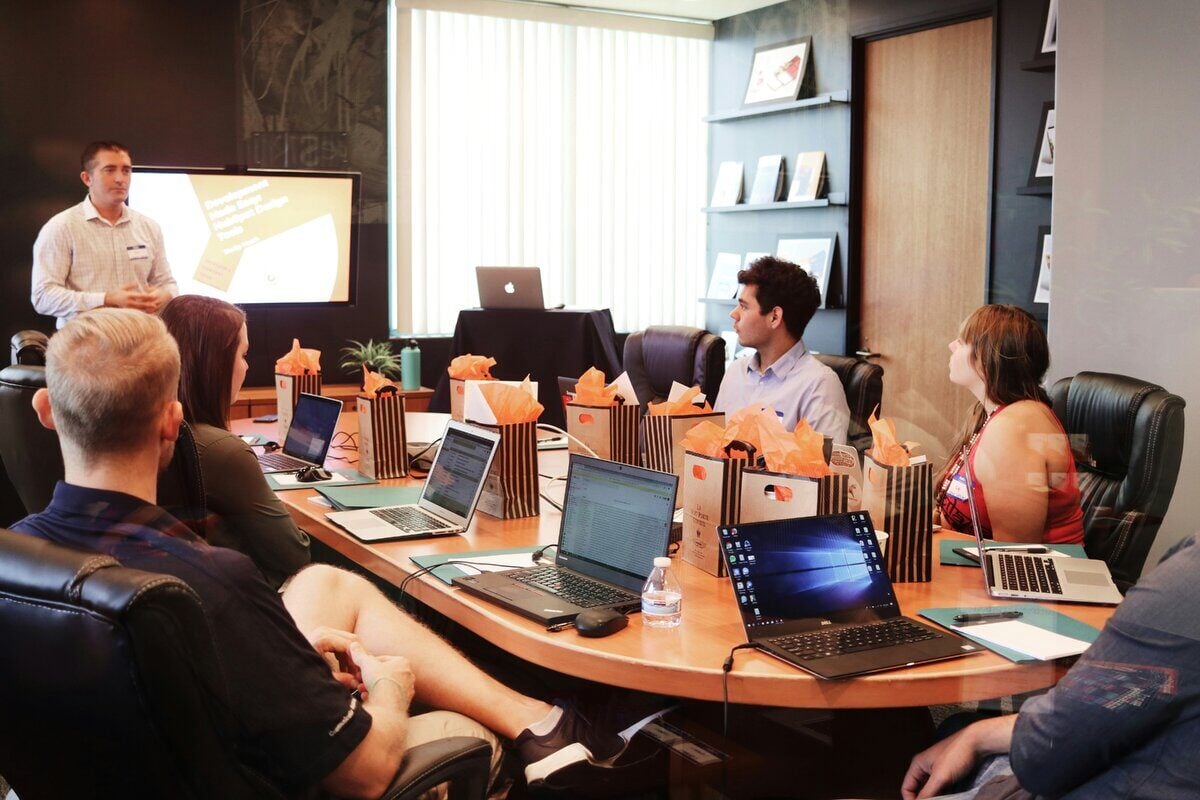
image alt text: Four colleagues review sticky notes on a glass wall during a planning session in a modern office.
Where does your team sit?
If different departments land in different rows, place the group you are designing training for.
|
Sounds like us if… |
Stage |
|
We are not using AI yet and are still working out where it might fit. |
Exploring |
|
A few people use AI on their own, and what they learn stays with them. |
Experimenting |
|
AI is becoming part of how we work, but people use it unevenly. |
Integrating |
|
We have adopted AI across the organization and want to know what it has improved. |
Scaling |
Matching AI training for employees to your stage
Whatever stage your team is in, decide whether people need to perform well with AI or keep the ability to do the work without it. People can produce strong work with AI on unfamiliar tasks without building lasting knowledge.⁴ For some tasks that is acceptable, as long as someone with expertise reviews the output. For others, such as an adjuster handling a claim during an outage or a new loan officer who will one day review AI-drafted work, training has to build workforce AI skills that hold up without the tool, through practice, recall, and feedback over time.
Our AI Learning Services start with that decision: the work people do, what good performance looks like in it, and the learning that closes the gap.
Find your next step
In the end, both organizations had to know where they stood before they could choose the right training. The credit union needed to know where AI helps and where it falls short before making training mandatory. The insurer needed adjusters who check AI’s work and a way to measure whether all its AI use was improving claims.
Ready to find the right next step for your team?
The AI Training Snapshot takes about a minute to complete and helps you identify where your organization stands in its AI journey. You'll receive stage-specific priorities and a practical exercise you can use with your team this week.

Sources
1 Dell’Acqua, F., McFowland, E., III, Mollick, E., Lifshitz, H., Kellogg, K. C., Rajendran, S., Krayer, L., Candelon, F., & Lakhani, K. R. (2026). Navigating the jagged technological frontier: Field experimental evidence of the effects of artificial intelligence on knowledge worker productivity and quality. Organization Science, 37(2), 403–423. https://doi.org/10.1287/orsc.2025.21838
2 Lee, H.-P., Sarkar, A., Tankelevitch, L., Drosos, I., Rintel, S., Banks, R., & Wilson, N. (2025). The impact of generative AI on critical thinking: Self-reported reductions in cognitive effort and confidence effects from a survey of knowledge workers. In Proceedings of the 2025 CHI Conference on Human Factors in Computing Systems (Article 1121, pp. 1–22). Association for Computing Machinery. https://doi.org/10.1145/3706598.3713778
3 Brynjolfsson, E., Li, D., & Raymond, L. (2025). Generative AI at work. The Quarterly Journal of Economics, 140(2), 889–942. https://doi.org/10.1093/qje/qjae044
4 Wiles, E., Krayer, L., Abbadi, M., Awasthi, U., Kennedy, R., Mishkin, P., Sack, D., & Candelon, F. (2026). Generative AI and the temporary upskilling of knowledge workers. Nature Human Behaviour. https://doi.org/10.1038/s41562-026-02566-6
AI Use Disclosure: This article was developed with the assistance of generative AI for drafting, refinement, and editorial support. The author reviewed, revised, and vetted the content and takes responsibility for the accuracy, conclusions, and final published version.